hello world, i'm
Rakshithaa
An engineer with a passion for exploring what AI can really do. Currently a research assistant at the Reading + Learning Lab, building AI that actually teaches.
$

An engineer with a passion for exploring what AI can really do. Currently a research assistant at the Reading + Learning Lab, building AI that actually teaches.


I've been really interested in this intersection of AI and how people actually learn. Not just building models that perform well on benchmarks, but figuring out how to make AI that genuinely helps someone think better. What does it look like when a system scaffolds your reasoning instead of just giving you the answer? That's the kind of stuff I think about a lot.
Lately I've been going down this rabbit hole of brain-computer interfaces and how the brain processes learning, and I kind of never came back. Mathis (2026) in Nature Neuroscience talks about "adaptive intelligence," basically how biological brains adjust on the fly in ways AI still can't. DeepMind put out a cognitive taxonomy paper that flagged five out of ten cognitive abilities (learning, metacognition, attention, executive functions, social cognition) as not even having good AI benchmarks yet. And NeuroChat (2025, ACM CUI) used EEG-based engagement tracking with an AI tutor. Students felt more engaged but didn't actually learn more. That gap between feeling like you're learning and actually learning really stuck with me.
Neuroscience has become one of my favorite rabbit holes lately. I think if you actually want to build AI that works well with people, it helps to understand how people think in the first place. Papers on how the brain learns, adapts, and processes information are just genuinely fun reads for me right now. It's one of those things where the more I read, the more connections I see to the AI work I'm already doing.
When I'm not in the lab I'm probably at the gym (strength training has become a whole thing), scrolling through my ever-growing collection of photos of my dog Yuuki back in India for a serotonin boost, or watching anime that makes me feel too many things. Frieren, Poco's Udon World, Naruto. I'll read a paper about brain-computer interfaces for fun and then go home and play Stardew Valley for four hours. I like a lot of different things and I don't think that needs an explanation.
My thesis investigates how LLM-powered tutoring can improve learning outcomes in introductory programming courses. I'm studying how AI tutoring interactions affect student understanding across different skill levels, with a controlled experiment design.
Multiple tutoring approaches tailored to how students learn, each designed to support different problem-solving styles.
Students are guided to topics where they need the most help, based on initial assessment.
Built-in safeguards to ensure the AI helps students think through problems rather than giving answers directly.
Developed an AI chatbot for correcting misconceptions about AI using GPT-4.1 via the OpenAI API, deployed on AWS Lambda with a Qualtrics-embedded frontend. Ran a between-subjects Prolific study with 200 participants across control, simple refutation, and empathetic refutation conditions, where each participant completed three four-round conversations targeting distinct AI misconceptions. Currently building an LLM-based adaptive tutoring system for introductory programming with survey integration, session management, and interaction logging.
Presentations: Psychonomic Society 2025 (poster) • ST&D 2026 (spoken presentation)
TA for EE3005 in the ECE department, supporting students through coursework, labs, and office hours.
Built an NLP + ML pipeline for multi-label Surgical Site Infection classification across 8,016 surgical encounters. Engineered 40+ polarity-aware NLP features from 6 clinical note types using BioMedICUS and a 172-concept UMLS lexicon. Trained XGBoost, CatBoost, and LightGBM with Optuna optimization, achieving F1 scores of 0.85–0.94 on a <3% prevalence dataset.
Built NLP pipelines for clinical text classification at UMN Medical School. The challenge was extracting structured labels from messy, unstructured clinical notes where doctors write in shorthand and abbreviations.
Key finding: Feature engineering on clinical text (n-grams, negation detection) mattered more than model complexity. XGBoost + Optuna beat deep learning approaches while being interpretable, which matters in clinical settings.
Created an arbitrary style transfer system that combines ResNet34, multi-level AdaIN, a U-Net style decoder, and optional Depth Anything V2 conditioning to preserve scene structure during stylization.
Key findings: training ResNet34 from scratch reduced content loss compared with the VGG-style baseline; depth-aware outputs preserved edges and layout better but reduced style intensity; direct QAT gave cleaner INT8 TensorRT results than PTQ.
Built a local SEC filing question-answering system with deterministic XBRL lookups for financial facts and ratios, plus RAG over filing text for narrative questions.
Key findings: XBRL and RAG routes performed similarly on FinanceBench, while retrieval recall remained the main bottleneck for narrative answers. The project also includes EDGAR ingestion, FAISS indexing, citations, local Ollama inference, Docker workflows, and a FastAPI + React interface with persisted chat history.
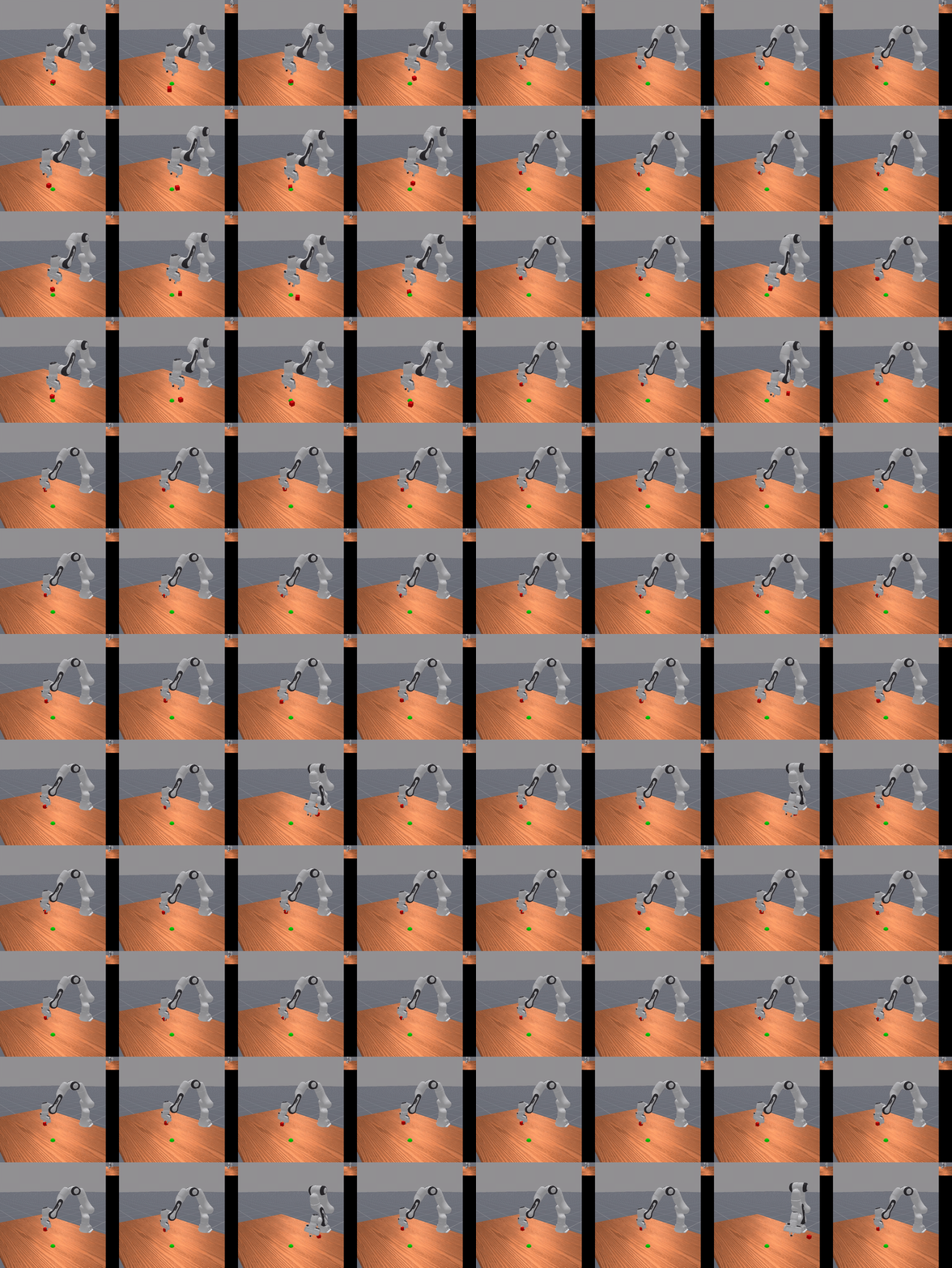
Training a Panda arm to pick up a cube in ManiSkill using DDPG with a spiking neural network actor. Compares conventional SAC and DDPG baselines against an SNN-DDPG variant where the policy head uses population-coded LIF neurons with surrogate gradients. Runs on both state-only and 64x64 RGB observations.
Key finding: Spiking policies can represent smooth continuous actions for contact-rich manipulation, but fine motor control remains challenging. State-only runs help isolate reward/control issues from perception bottlenecks.
Faster R-CNN with custom image enhancement for identifying marine species in degraded underwater imagery. Underwater images are noisy, color-shifted, and low-contrast, so preprocessing was half the battle.
Key finding: Domain-specific image enhancement (color correction, contrast normalization) improved detection accuracy more than switching to a bigger model. A reminder that data quality > model size.
Built a system where an LLM reasons about spatial tasks, YOLO detects objects, ViT classifies them, and 3D RRT* plans collision-free paths. The LLM acts as a high-level planner while traditional algorithms handle the low-level execution.
Key finding: LLMs are surprisingly good at spatial reasoning when given structured scene descriptions, but hallucinate object positions without visual grounding. The pipeline approach (LLM + vision + planning) worked better than end-to-end.
$ cat beyond_the_code.txt
[LOADING...]
🐶 YUUKI 🐶
SPECIES: golden labrador
STATUS: professional couch thief
HOBBY: blanket hoarding
CUTENESS: ██████████ MAX
NAPS/DAY: ██████████ YES
best girl in all of india & minnesota 💖
xX_n4rut0_f4n_Xx: believe it!! great site 🔥
stardew_girl_22: omg the konami code is genius
soma_survivor: WAP = what am i? the real horror is philosophy.
frieren_enjoyer: this page heals my soul
gym_bro_99: calisthenics gang rise up 💪